Euphrates River Watershed Rehabilitation Project
Background
Since the formation of the modern state in 1923, Türkiye has progressed well economically and has become an upper middle-income country with a GDP of USD 1.12 trillion and per capita income of USD 13,110 in 2023. In recent years, however, productivity gains have slowed. Adoption of a complex set of regulatory measures to direct credit to selected sectors and to promote greater use of the national currency in the economy has led to significant market pressure on the Lira. This, accompanied by the COVID-19 and the war in Ukraine, has added to pre-existing vulnerabilities. With GDP growth of 11 percent in 2021 and 5.5 percent in 2022, 4.5 percent in 2023, post COVID-19 recovery is impressive, nonetheless. More recent macroeconomic policies have helped to improve external balance, but vulnerabilities still remain.
The agriculture sector contributed 6.2% of GDP and employed about 14.6% of Türkiye's labour force in 2023. During 2010–19, real agricultural GDP grew at an annual rate of 2.7%. Economic gains achieved over the past two decades enabled Türkiye to lift nearly 30 percent of its population out of poverty. However, the headcount ratio, measured using the upper middle-income poverty rate of $6.85 in 2017, is relatively high at 12.9% in 2024. Even more concerning: the progress in reducing poverty has stalled in recent years. In general, upland, and mountainous areas, which are less connected and are more vulnerable to climate change risks, have higher rates of economic poverty and are subject to rural-urban outmigration.
Rationale
Despite the impressive economic achievements, Türkiye faces some development challenges. Monetary poverty is relatively high and Türkiye ranked relatively low in the Global Gender Gap Index, particularly. With over 44% of the population under the age of 30, Türkiye is a young nation. The unemployment rate among young people is high at 17.5% overall, and 23.4% for young women. As a result, while cities are getting crowded with young unemployed people, the farming population is growing older. In addition, rapid demographic growth, urbanisation, and industrialization is widening sustainability gaps. Productivity gains have slowed down.
Climate change is expanding the agricultural sector's exposure to climatic risks and the country now experiences more frequent extreme weather‐related events. With about 27% of its population living in water scarce areas, the level of water stress is substantial.
Agricultural growth in Türkiye has proven to be pro‐poor and can contribute even more to reduce poverty and make the economy more resilient. The proposed project area reports a high poverty rate as well as high agricultural growth. This fortuitous combination needs to be maintained and accelerated by allocating more resources for the development of agriculture and use of natural resources. In identifying and designing the proposed project, the GoT and IFAD have considered the impact of the two strong earthquakes that hit the region in February 2023 and resulted in the death toll of more than 50,000 people. Small-scale producers were particularly affected by the loss of livestock, the destruction of their houses as well as agricultural assets including barns and irrigation systems.
Since it became a member in 1982, Türkiye has demonstrated its political and economic commitment to the IFAD supported programme. Importantly, a successful model for tackling the issues in upland and mountainous areas in Türkiye's Eastern and SouthEastern regions has evolved with the implementation of the IFAD supported Murat River Watershed Rehabilitation Project (MURAT).
At completion point in 2023 this project was rated highly relevant and secured satisfactory results in terms of rural poverty impact, climate change adaptation, and gender equality and empowerment. The proposed Euphrates River Watershed Rehabilitation Project (FIRAT) builds on the firm foundation that MURAT has laid, while also introducing innovations that are expected to enhance the impact of the project on the targeted communities and households.
Goal and development objectives
FIRAT's goal will be to reduce poverty of the upland communities in the targeted MCs of the Euphrates River watershed.
The Project development objectives will be to increase the income and resilience of small-scale producers and vulnerable groups, including women and youth, in the targeted micro catchments (MCs).
The proposed project as designed is fully aligned and contributes directly to Türkiye's Vision for 2053 and caters directly to the themes of disaster-resilient habitats and sustainable environment identified in the 12th National Development Plan (2024-28).
FIRAT's major thrust during implementation will be on restoring the livelihood of the earthquake victims – an area that GoT has accorded a very high priority. FIRAT is also fully aligned with the second objective of mainstreaming sustainable natural resource management into all aspects of upland agricultural production and increasing upland climate change resilience identified in the Country Strategic Opportunities Programme (COSOP). Adequate attention has been paid in on-boarding lessons learnt in Türkiye including those from the country programme and strategy evaluation (CSPE) undertaken by IFAD's Independent Office of Evaluation (IOE).
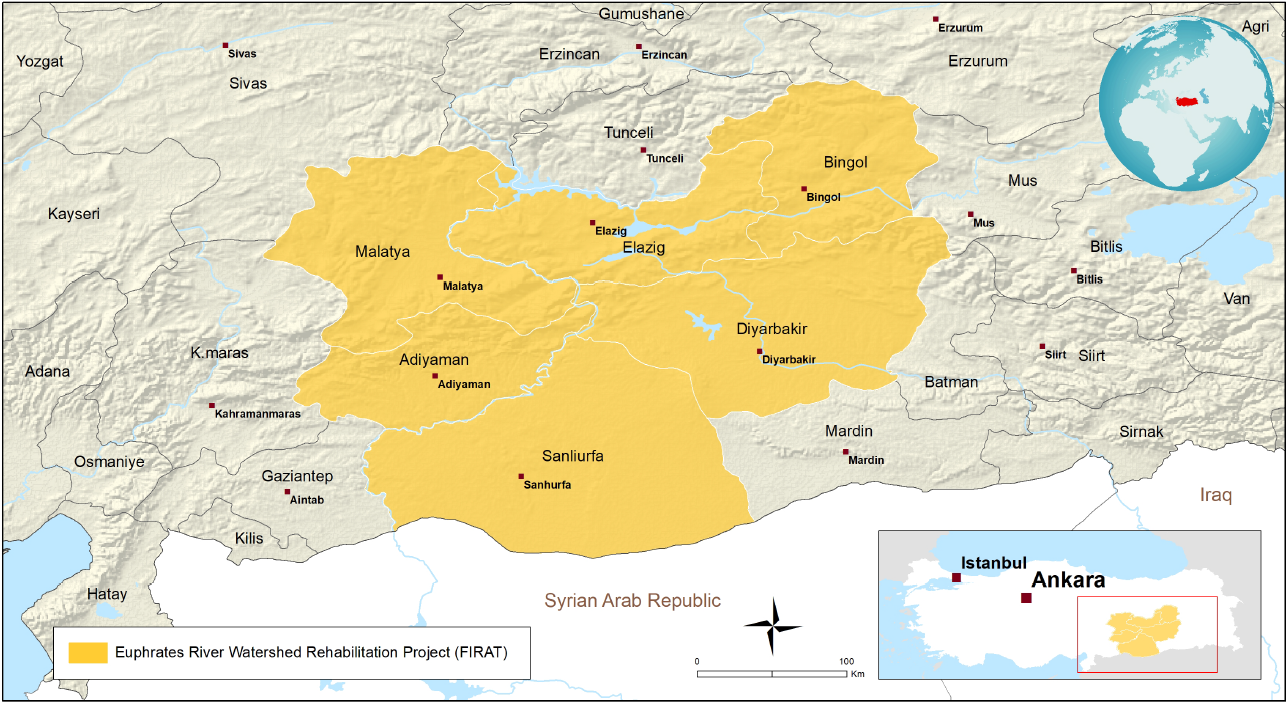
Target areas. FIRAT will target the remote upland areas and focus on livelihood diversification for small-scale producers to increase their resilience and income in approximately 40 MCs with 400 upland forest villages spread over 39 districts in the 6 targeted provinces (Şanlıurfa, Malatya, Diyarbakır, Adıyaman, and certain districts in Bingöl and Elazığ not targeted under the MURAT project). It will adopt the MC approach to integrate livelihood activities with natural resources restoration and sustainable management.
Map of the Project Area
Target Group
The main target group will be small-scale producers living in upland forest villages and engaged in a mixed farming system as their main livelihood. They have few productive assets and most of them have experienced loss or damage to these assets due to the earthquakes. Among these, women and very poor farmers who are not registered as farmers are likely to suffer most. Specific focus will be on vulnerable groups, in particular: (i) poor rural households practising subsistence farming who have some marketable surplus and whose livelihood is negatively affected by environmental degradation, climatic shocks, and disasters; (ii) women, with a sharper focus on women-headed households; and (iii) unemployed and underemployed rural youth.
Target group and micro catchment selection. Poorest households will be identified based on poverty criteria considering income level (e.g. monthly income below two times the minimum wage and/or green card holders); productive assets (e.g. less than 10 decars of land; less than 10 cows; less than 100 small ruminants and other considerations including no access to water/irrigation facilities. These households will be eligible for grant support as defined by the scheme modalities in the two project components.
Criteria for MCs selection are high levels of soil erosion and land degradation and high level of poverty and/or low level of socioeconomic development. In selecting the MCs in the first-year priority will be accorded to the MCs most affected by the earthquakes.
The total outreach is estimated at 140,000 individuals or 40,000 households (HHs), of which 27,000 households (HHs) are expected to receive multiple project services while 13,000 HHs will only benefit from community-level interventions. Women will account for 40% and youth for 15%.
Description of the project
The FIRAT goal and development objectives will be achieved through two technical components, via MC planning and natural resources management; and Investments in improved climate-resilient livelihoods and access to markets.
The MC planning and natural resources management component will support the development of 40 micro catchment plans (MCPs) including on average 10 villages in each MC and the implementation of activities related to the natural resources restoration and sustainable management. It is underpinned by two sub-components: (i) participatory micro-catchment planning and capacity building with focus on conducting an integrated assessment of the MC areas with the people living in the villages in the MCs and develop an MCP with an agreed Strategic Investment Plan (SIP) to be implemented in the Sub-component 1.2 as well as the component 2; and (ii) based on the MCP and SIP, the rehabilitation and sustainable management of natural resources aiming at reducing the risks of landslides and floods, ensuring resilient and sustainable livelihoods, and reducing sediments prolonging the life of the Atatürk and Karakaya Dams on the Euphrates River.
Under the second component entitled Investments in sustainable land management, climate resilient infrastructure, livelihoods and access to markets, FIRAT will based on the MCPs and SIPs invest in: (i) the recovery of production assets and diversification of agricultural production and economic activities in rural areas; (ii) marketing and the promotion of products from the participating provinces; and (iii) public irrigation infrastructure to be complemented with on-farm investments. Investments will be made in recovering assets lost or damaged by the earthquakes; for technologies, equipment and practices increasing climate resilience and productivity; and for adding value in aggregation and processing to increase sales and reduce food waste and loss.
The second component has 3 sub-components. The first sub-component establishes a Revolving Fund Facility for improving sustainable land management, climate resilient production infrastructure, aggregation, processing, and marketing which would support 4,800 youth to develop their capabilities to access wage employment as well as self-employment opportunities. It is noted that the term revolving fund is adopted in this context and elsewhere in the Project Design Report in recognition of the revolving element (50% in interest free loan) of the financing mechanism. Of the two windows within the revolving fund, the Window for poor and transitory poor producers will promote on-farm and off-farm investment by small-scale producers practising subsistence farming and selling surplus to markets by supporting them in: (i) post-earthquake recovery, (ii) increase their climate resilience and the productivity of crops and livestock with emphasis on integrated soil and water management practices, resources use efficiency and mechanical and digital solutions; (iii) enable them to meet standards to link to aggregators in value chains, (iv) and generally diversify their economic activities and reduce risks. The second window targeted at producer organisations and aggregators will support investments in production, processing, and marketing of agricultural products. The focus of this second window will be small-scale farmers' producer organisations (cooperatives, unions etc.) and eligible aggregators (MSME) of agricultural products. For livelihood investments, this subcomponent will build on ORKÖY's existing financing scheme for people living in upland forest villages while introducing changes that would make the scheme inclusive.
Under the second sub-component, FIRAT will focus on strengthening producer organisations and marketing to better capture emerging market opportunities in local, domestic and/or export markets and may involve investment opportunities such as construction of fruit-vegetable and/or animal marketplaces etc. This will be achieved through training of the management and technical staff on organisational governance, business management, knowledge exchange, promotion, and participation in domestic and international agricultural and trade events.
Under the third sub-component, FIRAT will invest in creating off-farm climate resilient water infrastructure that would enhance water use efficiency by reducing conveyance losses by upgrading dilapidated and inefficient small scale irrigation facilities based on open channels that are either nearing their end-of-life or were severely damaged during the earthquakes. Investments will be undertaken in selected locations where catchments possess restored vegetation cover as identified during the MC planning process and supported in sub-component 1.2. The irrigation schemes will enable small-scale agricultural producers to increase agricultural productivity as well as resilience to climate change and sustainability prospects.
The third component is cross-cutting and invests in institutional strengthening and project management and services the technical components and facilitates pathways for the effective and efficient implementation of project interventions. The institutional strengthening will be achieved through training, exchange visits, development or updating of technical guidelines and studies, the establishment or strengthening of existing partnerships, and the development of South-South and Triangular Cooperation opportunities. In designing FIRAT, priority has been accorded to optimising the project's operational efficiency, reign-in operating to investment cost ratio, and ensuring sustainability. These objectives will be achieved by mainstreaming FIRAT activities to the normal operations of General Directorate of Forestry (OGM), Regional Directorate of Forestry (OBMs) and other subsidiary units to the extent possible.
In order to promote a programmatic approach in the portfolio financed by IFAD in Türkiye, the Project Steering Committee to be established under FIRAT will work closely with the CPMU overseeing implementation of URDP to promote synergies between FIRAT and URDP (and any future projects to be developed under the currency of the IFAD13 lending cycle.
Environmental, social and climate risks and mitigation measures
The environmental and social category for FIRAT is proposed as Moderate. The project aims to generate overall positive environmental and social benefits in a comprehensive manner and will implement nature-based soil erosion control activities.
Afforestation and reforestation will be the key priority of FIRAT for the rehabilitation of biodiversity and degraded land and for improved resilience of livelihoods. Multiple purpose grass and trees will be selected for the plantation, while honey forest support will be continued.
Potential social risks consider that women, youth and other vulnerable categories and marginalised groups can be excluded from project benefits. Proactive efforts will be taken to target those individuals with fewer assets and opportunities, and address gender inequalities in accessing project Measures include: Pro-poor targeting criteria; strong outreach and communication activities; separate consultation with women, youth and vulnerable groups; incorporating use of GALS in capacity building services; gender and social inclusion experts are included full time as staff in the RPMUs.
The climate risk category of the project is proposed as Moderate. The forecasted effects of climate change in the project area include adverse impacts on surface water availability, increased occurrences of floods, prolonged periods of aridity and drought.
These effects are expected to disrupt agricultural output and pose some threats to food security, but will be limited, transient or manageable. Financial, environmental, and social underperformance or failure due to climatic hazards is unlikely. Considering the likely impact, FIRAT will promote climate resilient farming practices and provide support for water management and improving useefficiency to enable farmers to cope with drought and unpredictable precipitation.
FIRAT places a significant emphasis on social inclusion and to mitigate environment, social, and climate risks, a comprehensive Environmental, Social, and Climate Management Plan (ESCMP) has been prepared.
Monitoring and Evaluation and knowledge management
The M&E system of FIRAT will be built on the existing system of the OGM to be complemented by an automated MIS for planning, monitoring, analysis, and evaluation of data, to be developed at the start of the Project. The M&E system will be guided by the logical framework and will follow the IFAD COI measurement guidelines for periodic measurement of project results - activities, outputs, outcomes, and impact - in relation to agreed targets to monitor implementation performance, Annual Work Plan and Budget (AWPB) execution, outreach, and effectiveness of the targeting strategy. Where applicable, data will be disaggregated by gender and age.
Emphasis will be given to monitoring outreach and physical progress for each key output, as and when they are delivered, and outcomes as they emerge.
FIRAT will invest in good quality, evidence-based knowledge management to contribute both to the implementation and to the policy development processes. Emphasis will be laid on the sustained anchoring of technical and managerial knowledge among supported upland farmers and entrepreneurs so that they receive help in increasing productivity and enhancing post-project sustainability.
